Learn how 1.2379 tool steel crusher blades are manufactured for plastic recycling. Explore CNC machining, heat treatment, wear resistance, quality control, and on-demand production in Egypt.


In plastic recycling and size-reduction systems, crusher blades are the core working components. Their performance directly impacts throughput, particle size consistency, energy consumption, and overall machine uptime. Poor blade quality leads to rapid wear, frequent replacements, and costly production stoppages.
That is why manufacturers depend on advanced tool steel machining, especially using high-wear alloys such as 1.2379 tool steel, to produce durable, high-performance crusher blades for plastic recycling. When combined with precision CNC milling, controlled heat treatment, and disciplined finishing processes, these blades can withstand extreme mechanical stress and abrasive plastic streams for extended service life.
In Egypt, particularly in Cairo, on-demand manufacturing now enables recycling operators and equipment manufacturers to source precision blade machining quickly and reliably without long international lead times.
1.2379 tool steel (equivalent to AISI D2) is a high-carbon, high-chromium cold-work steel widely used for cutting and shearing applications.
These characteristics make it ideal for:
Compared to lower-alloy steels, 1.2379 maintains sharp edges longer and resists deformation even under continuous crushing loads.
Producing reliable wear-resistant cutting blades requires precise control at every stage of manufacturing.
High-performance blades begin with certified raw material from reputable suppliers such as Böhler or Assab.
Each batch is supplied with mill certificates verifying:
Material quality consistency ensures predictable hardening behavior and uniform wear performance across blade sets.
Before hardening, blades are machined from annealed tool steel using high-rigidity CNC milling machines.
Operations include:
Machining accuracy at this stage is critical because dimensional errors cannot be corrected once the steel is hardened.
Multi-axis CNC milling ensures:
Heat treatment transforms the machined blanks into hardened cutting tools.
Typical heat treatment cycle for 1.2379 includes:
Target hardness range: 58–62 HRC, adjusted based on:
Incorrect heat treatment can result in cracking, brittleness, or uneven hardness — making this step central to long blade life.
After heat treatment, blades undergo surface grinding to restore flatness and achieve final dimensional tolerances.
Grinding achieves:
Final honing may be applied depending on machine design and material type being processed. Proper finishing ensures:
This stage is essential for precision blade machining and operational reliability.
1.2379 tool steel crusher blades are widely used in:
They process materials such as:
Higher contamination levels increase abrasion, making tool steel selection and heat treatment quality even more critical.
A leading plastic tube manufacturer in Egypt has its own recycling plant in house, they’re operating high-capacity shredders experiencing excessive blade wear, requiring replacement every 6–8 weeks. Frequent shutdowns increased labor costs and reduced daily throughput.
Entag produced a new blade set using certified 1.2379 tool steel from Bohler. Precision CNC milling ensured consistent edge geometry and accurate mounting alignment.
The blades underwent vacuum heat treatment to reach 60 HRC, followed by precision surface grinding to maintain flatness within ±0.02 mm.
Hardness and geometry were verified across all blades before delivery.
The recycling facility achieved higher output with lower operating costs and fewer emergency shutdowns.
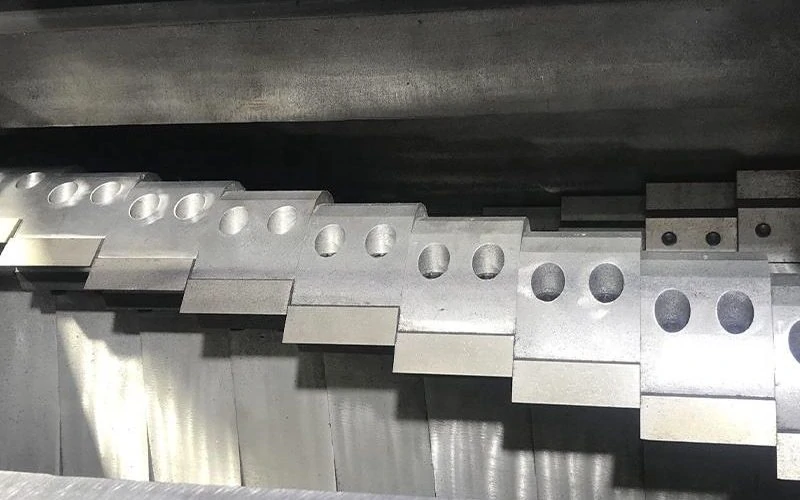
Consistent blade performance depends on rigorous inspection:
For batch production, statistical inspection ensures uniformity across blade sets, preventing imbalance issues in high-speed rotors.
Entag controls inspection internally as part of its manufacturing workflow, ensuring accountability across all stages.
On-Demand Tool Steel Blade Manufacturing in Egypt
Traditional sourcing of crusher blades often involves:
With on-demand manufacturing, operators can:
In Cairo and across Egypt, Entag manages machining, heat treatment, inspection, and logistics — acting as the single accountable manufacturing interface to ensure quality and speed.
Plastic recycling efficiency depends heavily on cutting tool performance. When properly manufactured, 1.2379 tool steel crusher blades deliver exceptional wear resistance, dimensional stability, and cutting consistency.
Through controlled tool steel machining, precision CNC milling, disciplined heat treatment, and strict inspection, blade life can be dramatically extended while reducing downtime and maintenance costs.
For recycling operations requiring fast, reliable blade replacement, on-demand hardened steel blade manufacturing in Egypt provides a practical and cost-effective solution.
If your operation depends on consistent cutting performance, Entag delivers custom CNC-machined 1.2379 tool steel crusher blades with full heat treatment and quality assurance.
Upload your blade design today and receive an on-demand quote — manufactured in Egypt, built for maximum durability.
Because it offers excellent wear resistance, high hardness, and good dimensional stability, making it ideal for continuous cutting of abrasive plastics.
Yes. Its high chromium content improves resistance to abrasive fillers and impurities often found in post-consumer plastics.
Service life depends on plastic type and operating conditions, but properly heat-treated 1.2379 blades often last 2–3× longer than lower-alloy steel alternatives.
Yes. Blade thickness, hole patterns, cutting angles, and profiles can all be customized to match specific shredder or granulator models.
Absolutely. On-demand manufacturing allows fast production and delivery without waiting for bulk imports or large batch scheduling.