In high-volume packaging, a minor geometry error in a sauce cap isn't just a mistake—it's a financial disaster. Inadequate thread engagement or poor seal compression leads to leakage, oxidation, and massive scrap rates. For manufacturers in Egypt, discovering these defects after cutting expensive injection molds results in prohibitive costs and line downtime.
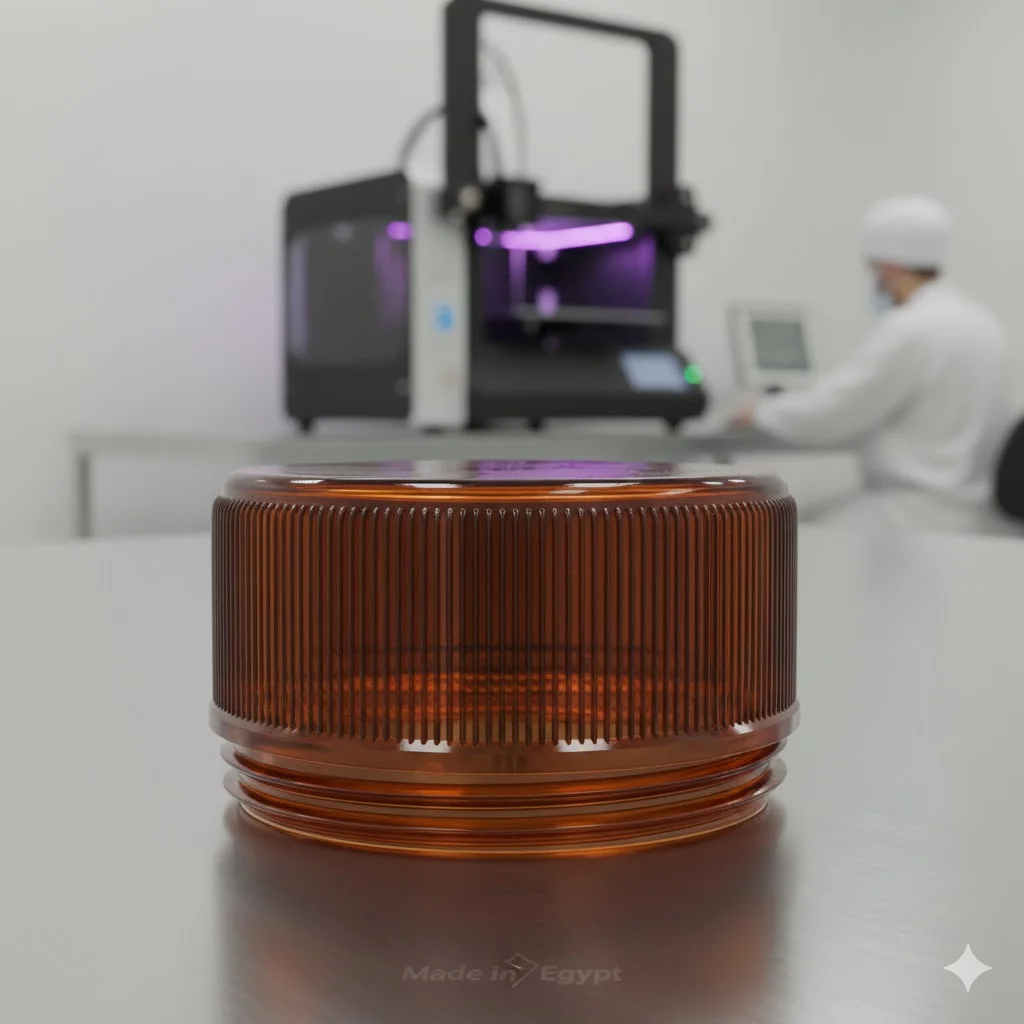


In high-volume food packaging production, a minor geometry error in a sauce cap design can lead to catastrophic operational failures. Inadequate thread engagement, poor seal compression, or interference with automated capping lines results in leakage, product oxidation, and significant scrap rates during initial pilot runs.
For manufacturers in Egypt, the cost of discovering these defects only after cutting expensive injection molds is prohibitive. Operational risks include not just the loss of raw materials, but the extended downtime of filling lines while molds are shipped back for rework. Utilizing SLA 3D printed sauce caps for functional testing allows engineers to validate mechanical fit and closure torque before committing to mass production, effectively mitigating the risk of expensive engineering changes.
Sauce caps serve as the primary barrier between the product and the environment. In a production environment, these components must perform the following functions:
The use of stereolithography resin printing is prevalent in the beverage, condiment, and pharmaceutical sectors. Failure to achieve tight tolerances (typically $\pm0.05\text{mm}$) in the prototyping stage leads to inaccurate seal testing, resulting in post-launch recalls or line-stoppages.
Material selection for food packaging prototypes requires a balance between aesthetic detail and mechanical performance. For sauce caps, "Tough" or "ABS-like" resins are typically selected over standard resins.

When specifying resin for high-detail plastic printing, engineers must understand how the photopolymer compares to industrial thermoplastics.
| Material Property | SLA Resin (Tough/ABS-Like) | AISI / ASTM Equiv. (Simulated) | ISO/DIN Equiv. | Common Brand Names |
|---|---|---|---|---|
| High Stiffness | Rigid Resin | Glass-Filled Nylon | PA GF30 | PerFORM / Somos PerFORM |
| Impact Strength | Tough Resin | ABS / Polypropylene | ABS / PP | Durable / Taurus |
| High Temp | High-Temp Resin | PEEK / PTFE | PEEK | HT Resin / Temp 300 |
| Transparency | Clear Resin | PMMA / Polycarbonate | Acrylic / PC | Watershed / Accura ClearVue |
The production of custom plastic components via SLA follows a rigorous industrial workflow:
To ensure rapid prototyping services meet industrial standards, the following QC steps are mandatory:
In the prototyping phase, selecting the wrong additive technology leads to false negatives during functional testing. SLA (Stereolithography) is the industrial standard for sauce caps because it provides isotropic properties and a hermetic seal that FDM (filament) cannot achieve. While FDM is faster for bulky jigs, its surface finish ($Ra > 12.5 \mu m$) is too coarse for liquid-tight seals and its porous layers often lead to vacuum leaks.
Engineers seeking specific mechanical properties can match SLA resins to traditional industrial thermoplastics. Rigid Resins serve as functional equivalents to Glass-Filled Nylon (PA GF30) for high-stiffness applications. Tough Resins are engineered to simulate the impact strength and fatigue resistance of ABS or Polypropylene, making them ideal for "snap-fit" closures. For high-temperature environments, High-Temp Resins provide thermal stability comparable to PEEK, while Clear Resins offer the optical clarity of PMMA or Polycarbonate for transparent dispensers.
A critical oversight in many rapid prototyping services is the failure to account for polymer shrinkage. During the UV post-curing stage, resins undergo a chemical cross-linking that slightly reduces part volume. At our Cairo facility, we utilize a Global Shrink Factor (GSF) compensation strategy.
By analyzing the specific resin’s shrinkage rate—typically between 0.5% and 1.2%—we scale the CAD geometry on the X, Y, and Z axes before printing. This ensures that the final SLA 3D printed sauce caps maintain perfect concentricity and thread engagement, allowing for accurate torque testing on automated filling lines without the risk of the cap being undersized for the bottle neck.

Project Spotlight: Validating a High-Speed Condiment Cap
Choosing local rapid prototyping services in Cairo provides a distinct advantage for Egyptian manufacturers. By eliminating international shipping and customs delays, engineers can receive functional prototypes within 48–72 hours, allowing for immediate design iterations and faster time-to-market.
In the Egyptian industrial landscape, importing specialized plastic components often involves lead times of 4 to 6 weeks. For packaging plants in areas like 6th of October City or 10th of Ramadan, this delay is unacceptable during a product launch. Local production of custom plastic components using SLA technology bridges this gap, allowing maintenance and R&D teams to troubleshoot production line issues without waiting for overseas shipments.
The transition from digital design to physical production is fraught with risk. SLA 3D printed sauce caps provide a high-fidelity, mechanically sound method for validating packaging designs before mass manufacture. By prioritizing material discipline and rigorous inspection, manufacturers can significantly reduce their total cost of ownership and ensure the reliability of their production lines.
Entag provides industrial-grade SLA 3D printing for the food and beverage industry in Cairo, Egypt. Our facility is equipped to handle complex geometries with high-detail resin materials.
No. While SLA resins are excellent for form and fit prototyping, they are generally not certified for long-term food contact. For functional testing, we recommend using a food-grade coating or limiting contact to short-term testing.
Standard lead times for high-detail caps in Cairo range from 3 to 5 business days, depending on post-processing requirements.
Yes, provided a specialized High-Temp resin is used. We can manufacture components that withstand temperatures up to 200°C without significant deformation.
Absolutely. The high Shore D hardness and dimensional accuracy allow them to be fed through sorting bowls and tightened by capping chucks for mechanical validation.
SLA is preferred for complex internal geometries and fine threads. CNC is recommended if the exact end-use production material (like pure HDPE) is required for chemical testing.