Technologies
CNC machining vs 3D printing is the first decision most hardware engineers and procurement managers face when sourcing a custom part, and the right choice depends on tolerance, material, order volume, and timeline.


CNC machining vs 3D printing is the first decision most hardware engineers and procurement managers face when sourcing a custom part. Get this call right and you save on tooling cost, lead time, and rework.
CNC machining vs 3D printing is the first decision most hardware engineers and procurement managers face when sourcing a custom part. Get this call right and you save on tooling cost, lead time, and rework. The right choice depends on tolerance, material, order volume, and timeline.
Both processes produce a working part from a CAD file, but they get there through opposite mechanical approaches, and that difference shapes cost and lead time before a purchase order gets signed.
The short version: use CNC machining when the part needs tight tolerances, a functional thread, a press fit, or the exact production material. Use 3D printing when you need a part fast, the geometry is too complex to cut, or you're ordering fewer than 10 units. The full breakdown, a decision checklist, and a comparison table are below.
Sourcing the typical way means separate vendors for prototyping and production, minimum order quantities that block small batch work, and quotes that add days before a job even starts.
Sourcing through Entag means one partner for both processes, no minimum order quantity, and lead times from 3 business days (7 for CNC).
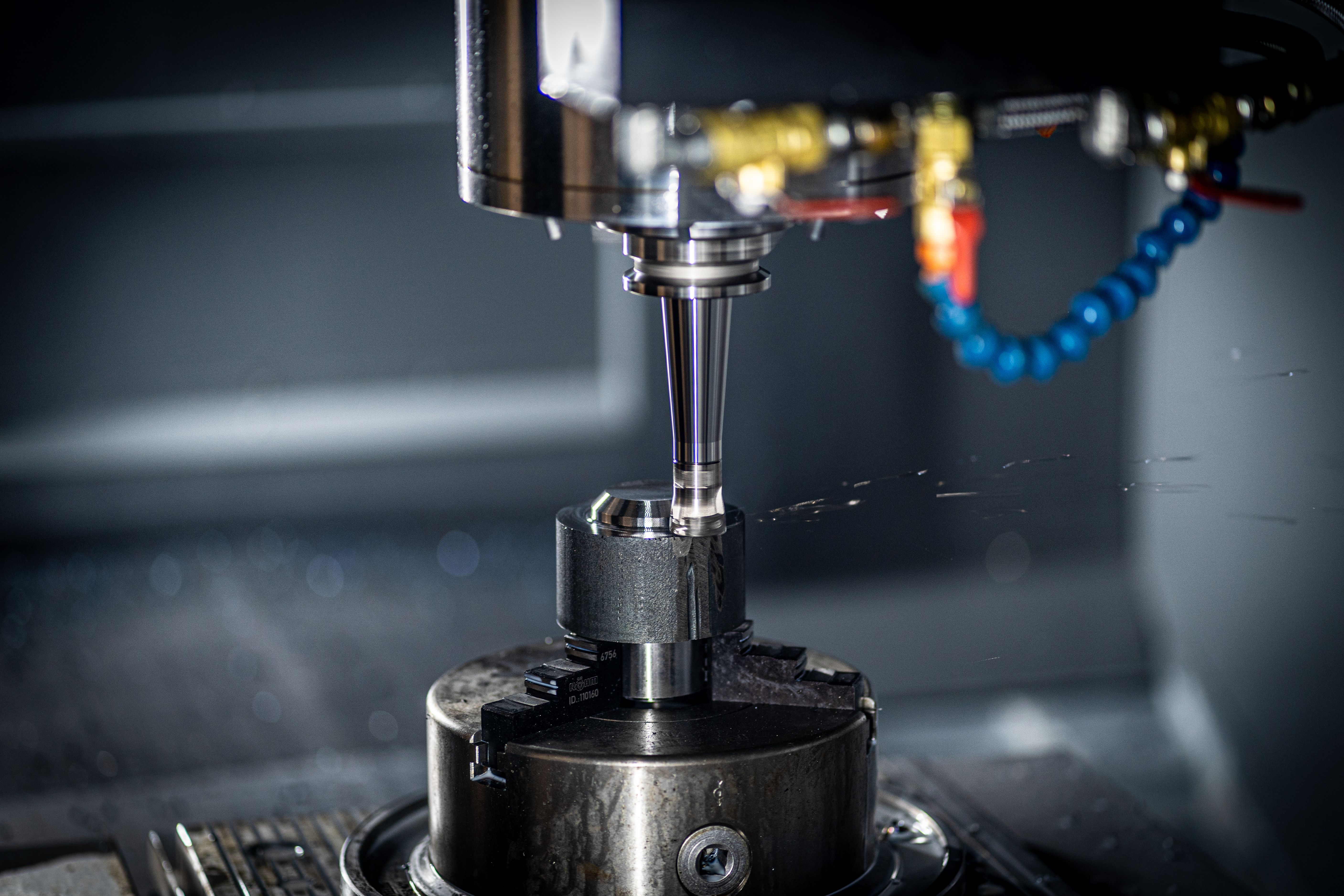
CNC machining is a subtractive process. A mill, lathe, or multi-axis machining center starts with a solid block of metal or plastic and removes material with a rotating cutting tool until the finished geometry remains.
3D printing is additive. It builds a part layer by layer, depositing or fusing material only where it's needed.
That single distinction explains most of what follows: how much raw material a job consumes, what tolerances are achievable, which materials are usable, and how a part behaves under load.
CNC machining removes material to reach final geometry. A complex part cut from billet stock can leave a substantial amount of the original block as scrap, sometimes the majority of it by weight.
3D printing builds close to net shape, so material use tracks closer to the part's actual volume, with waste generally limited to support structures and failed prints.
For high complexity, low volume parts, this makes 3D printing meaningfully more efficient. The gap narrows for parts machined from stock already close to final dimensions.
Tolerance is where CNC machining tends to win outright for functional, mating parts.
| Factor | CNC machining | 3D printing |
|---|---|---|
| Typical achievable tolerance | ±0.05mm to ±0.1mm, tighter with precision setups | ±0.1mm to ±0.5mm, process dependent |
| Surface finish out of the machine | Smooth, consistent | Visible layer lines unless post processed |
| Repeatability across a run | Very high | Moderate, varies by orientation and calibration |
| Best suited for | Bearing seats, press fit holes, threads, sealing surfaces | Complex internal geometry, organic shapes, low stress housings |
If a part needs to mate precisely with another component, hold a press fit, or carry a functional thread, this usually resolves in favor of machining.
If the part's geometry would be difficult or impossible to machine (internal lattices, undercuts, organic curves), 3D printing becomes the only practical option regardless of tolerance preference.
For more on how tight tolerances get specified and held, see our GD&T guide.
CNC machining works directly with production grade materials: aluminum, stainless steel, titanium, brass, and engineering plastics like PEEK, POM, and nylon, all machined from the same stock a final part would use.
That's a major reason machining tends to win out for parts headed toward functional testing or short run production. The prototype and the production part can come from identical material.
3D printing's material range depends heavily on the specific technology (FDM, SLA, SLS, or metal powder bed fusion). Even where metal 3D printing exists, it's a narrower and generally more expensive material set than what a CNC shop can machine directly from standard aluminum stock.
| Process | Typical material | Layer resolution | Best for |
|---|---|---|---|
| FDM (Fused Deposition Modeling) | ABS, PLA, PETG, nylon | 0.1mm to 0.3mm | Fast, low cost form check prototypes |
| SLA (Stereolithography) | Photopolymer resin | 0.025mm to 0.1mm | Smooth cosmetic parts, fine detail |
| SLS (Selective Laser Sintering) | Nylon (PA11, PA12) | 0.08mm to 0.15mm | Functional parts with complex geometry, no support structures needed |
| Metal powder bed fusion | Aluminum, titanium, stainless steel | 0.02mm to 0.08mm | Functional metal parts with internal features CNC can't reach |
Once 3D printing is the right call, the specific process still needs to match the part's material and finish requirements, not just its geometry.
CNC router vs 3D printer comparisons usually come from a maker or hobbyist context, not an industrial sourcing one. A desktop CNC router and a desktop FDM printer are both entry level tools working with soft materials (wood, foam, basic plastics) at loose tolerances.
Neither represents what an industrial CNC machining center or production grade additive system can deliver. For procurement decisions on functional custom parts, the relevant comparison is between industrial multi-axis CNC machining and industrial grade additive manufacturing, not consumer desktop equipment.
At Entag, 3D printing and rapid prototyping jobs can move in as little as 3 business days. CNC machining, which requires programming, tool setup, and often multiple operations, typically starts at 7 business days depending on complexity and material.
Cost runs in reverse. 3D printing has minimal setup cost, so a single part or a short run of 1 to 5 units is often cheaper to print than machine. CNC machining carries fixed setup costs (fixturing, tool paths, programming) spread across the quantity ordered.
As volume climbs into the dozens or hundreds, machining's per part cost typically overtakes 3D printing's low volume flexibility. That setup cost amortizes across more parts, and machining's material and cycle time efficiency scale better at volume.
This matters directly to procurement managers sourcing for regulated sectors. Aerospace and defense, oil and gas, and dental and medical industries typically require material certifications and traceability documentation.
CNC machining, using certified mill and bar stock with a documented chain of custody, is generally better positioned to support this than most 3D printing workflows, where batch traceability standards are still maturing. If a part is headed into a regulated assembly, confirm requirements with your manufacturing partner before committing to either process.
Many manufacturing platforms impose a minimum order quantity that makes single part or small batch custom work economically impractical. Entag operates without a minimum order quantity, so both CNC machining and 3D printing are genuine options for a single prototype, not just production volume runs.
For procurement managers sourcing one off replacement parts, fixtures, or evaluation units, this removes a constraint that otherwise forces a choice based on order size rather than the part's actual engineering requirements.
Representative scenario, automotive / consumer goods. An engineering team needs a custom mounting bracket that must survive vibration testing and mate precisely with an existing bolt pattern. The part is aluminum, needs a tolerance tighter than ±0.1mm at the mounting holes, and must match the final production material, not a proxy plastic.
3D printing could produce a form check version in a day, useful for confirming clearances and fit. The functional prototype, the one that gets vibration tested, needs to be CNC machined from the same 6061-T6 aluminum the final part will use.
This is a common pattern across custom parts sourcing: 3D printing for form and fit checks early, CNC machining once the part needs to perform, not just fit.
For most custom parts programs, the answer isn't choosing one process permanently, it's using both at different stages. A common workflow: 3D print the first design iterations to validate form and fit quickly and cheaply, then move to CNC machining once the design is locked and the part needs the actual target material for functional testing or production.
Entag supports both directly, so a design can move from 3D printed iteration to CNC machined functional part without switching manufacturing partners. The same design locking logic applies to sheet metal parts: our sheet metal bending design guidelines cover the equivalent decisions for formed metal components.
Is CNC machining more accurate than 3D printing?
Yes, for most functional parts. CNC machining typically holds ±0.05mm to ±0.1mm, tighter with precision setups, while 3D printing typically holds ±0.1mm to ±0.5mm depending on the process. For bearing seats, press fit holes, and threads, CNC machining is the more reliable choice.
Is 3D printing cheaper than CNC machining?
For low volumes, usually. A single part or a run of 1 to 5 units is often cheaper to 3D print because CNC machining carries fixed setup costs (fixturing, tool paths, programming) that get spread across the order. As quantity climbs into the dozens or hundreds, CNC machining's per part cost typically drops below 3D printing's.
Can 3D printed parts be as strong as CNC machined parts?
It depends on the process and material. SLS nylon and metal powder bed fusion parts approach the mechanical properties of machined parts in many applications, but FDM and SLA parts are generally weaker along the layer lines than a machined part cut from solid stock. For parts headed to vibration testing or load bearing use, CNC machining from the actual production material is the safer choice.
What is the minimum order quantity for CNC machining or 3D printing at Entag?
There is no minimum order quantity. Entag produces a single prototype part through either process, as well as production volume runs, without the order size constraints common on other manufacturing platforms.
How long does CNC machining take compared to 3D printing?
At Entag, 3D printing and rapid prototyping jobs move in as little as 3 business days. CNC machining jobs typically start at 7 business days, since they require programming, tool setup, and often multiple operations, depending on part complexity and material.
Which is better for prototypes, CNC machining or 3D printing?
3D printing suits early form and fit checks: it is fast and inexpensive for validating geometry against surrounding components. Once a design is locked and a prototype needs to survive functional testing (vibration, load, thermal), CNC machining from the actual production material gives a result that behaves like the final part.
CNC machining vs 3D printing doesn't have one universal answer. It depends on tolerance requirements, material needs, order volume, timeline, and whether the part is headed toward a regulated application. What matters is having a manufacturing partner who can execute either process, or move a design between both as it develops, without forcing a compromise based on which capability happens to be available.
Entag manages CNC machining, 3D printing, sheet metal fabrication, and additive manufacturing production directly, with no minimum order quantity and lead times starting from 3 business days.
{
"@context": "https://schema.org",
"@type": "TechArticle",
"headline": "CNC Machining vs 3D Printing for Custom Parts: The Complete Comparison Guide",
"description": "Compare CNC machining and 3D printing on tolerance, material, cost, and lead time, then get a quote from Entag with no minimum order and delivery from 3 days.",
"url": "https://www.entag.co/blog-portal/cnc-machining-vs-3d-printing-comparison-guide",
"datePublished": "2026-08-20",
"dateModified": "2026-08-20",
"proficiencyLevel": "Expert",
"author": {
"@type": "Organization",
"name": "Entag",
"url": "https://www.entag.co"
},
"publisher": {
"@type": "Organization",
"name": "Entag",
"url": "https://www.entag.co",
"logo": {
"@type": "ImageObject",
"url": "https://www.entag.co/logo.png"
}
},
"inLanguage": "en"
}
{
"@context": "https://schema.org",
"@type": "FAQPage",
"mainEntity": [
{
"@type": "Question",
"name": "Is CNC machining more accurate than 3D printing?",
"acceptedAnswer": {
"@type": "Answer",
"text": "Yes, for most functional parts. CNC machining typically holds ±0.05mm to ±0.1mm, tighter with precision setups, while 3D printing typically holds ±0.1mm to ±0.5mm depending on the process. For bearing seats, press fit holes, and threads, CNC machining is the more reliable choice."
}
},
{
"@type": "Question",
"name": "Is 3D printing cheaper than CNC machining?",
"acceptedAnswer": {
"@type": "Answer",
"text": "For low volumes, usually. A single part or a run of 1 to 5 units is often cheaper to 3D print because CNC machining carries fixed setup costs (fixturing, tool paths, programming) that get spread across the order. As quantity climbs into the dozens or hundreds, CNC machining's per part cost typically drops below 3D printing's."
}
},
{
"@type": "Question",
"name": "Can 3D printed parts be as strong as CNC machined parts?",
"acceptedAnswer": {
"@type": "Answer",
"text": "It depends on the process and material. SLS nylon and metal powder bed fusion parts approach the mechanical properties of machined parts in many applications, but FDM and SLA parts are generally weaker along the layer lines than a machined part cut from solid stock. For parts headed to vibration testing or load bearing use, CNC machining from the actual production material is the safer choice."
}
},
{
"@type": "Question",
"name": "What is the minimum order quantity for CNC machining or 3D printing at Entag?",
"acceptedAnswer": {
"@type": "Answer",
"text": "There is no minimum order quantity. Entag produces a single prototype part through either process, as well as production volume runs, without the order size constraints common on other manufacturing platforms."
}
},
{
"@type": "Question",
"name": "How long does CNC machining take compared to 3D printing?",
"acceptedAnswer": {
"@type": "Answer",
"text": "At Entag, 3D printing and rapid prototyping jobs move in as little as 3 business days. CNC machining jobs typically start at 7 business days, since they require programming, tool setup, and often multiple operations, depending on part complexity and material."
}
},
{
"@type": "Question",
"name": "Which is better for prototypes, CNC machining or 3D printing?",
"acceptedAnswer": {
"@type": "Answer",
"text": "3D printing suits early form and fit checks: it is fast and inexpensive for validating geometry against surrounding components. Once a design is locked and a prototype needs to survive functional testing (vibration, load, thermal), CNC machining from the actual production material gives a result that behaves like the final part."
}
}
]
}
(function(){var l1=document.createElement("link");l1.rel="alternate";l1.hreflang="en";l1.href="https://www.entag.co/blog-portal/cnc-machining-vs-3d-printing-comparison-guide";document.head.appendChild(l1);var l2=document.createElement("link");l2.rel="alternate";l2.hreflang="ar-EG";l2.href="https://www.entag.co/blog-portal/ar-cnc-machining-vs-3d-printing-comparison-guide";document.head.appendChild(l2);var l3=document.createElement("link");l3.rel="alternate";l3.hreflang="x-default";l3.href="https://www.entag.co/blog-portal/cnc-machining-vs-3d-printing-comparison-guide";document.head.appendChild(l3);})();
{
"@context": "https://schema.org",
"@type": "BreadcrumbList",
"itemListElement": [
{
"@type": "ListItem",
"position": 1,
"name": "Home",
"item": "https://www.entag.co"
},
{
"@type": "ListItem",
"position": 2,
"name": "Blog",
"item": "https://www.entag.co/blog-portal"
},
{
"@type": "ListItem",
"position": 3,
"name": "Technologies",
"item": "https://www.entag.co/blog-portal"
},
{
"@type": "ListItem",
"position": 4,
"name": "CNC Machining vs 3D Printing for Custom Parts: The Complete Comparison Guide",
"item": "https://www.entag.co/blog-portal/cnc-machining-vs-3d-printing-comparison-guide"
}
]
}

