Explore how 3D scanning enhances reverse engineering, CAD reconstruction, inspection, and prototyping. Learn how manufacturers in Egypt use 3D laser scanners to generate accurate 3D models and drawings for CNC machining and 3D printing.
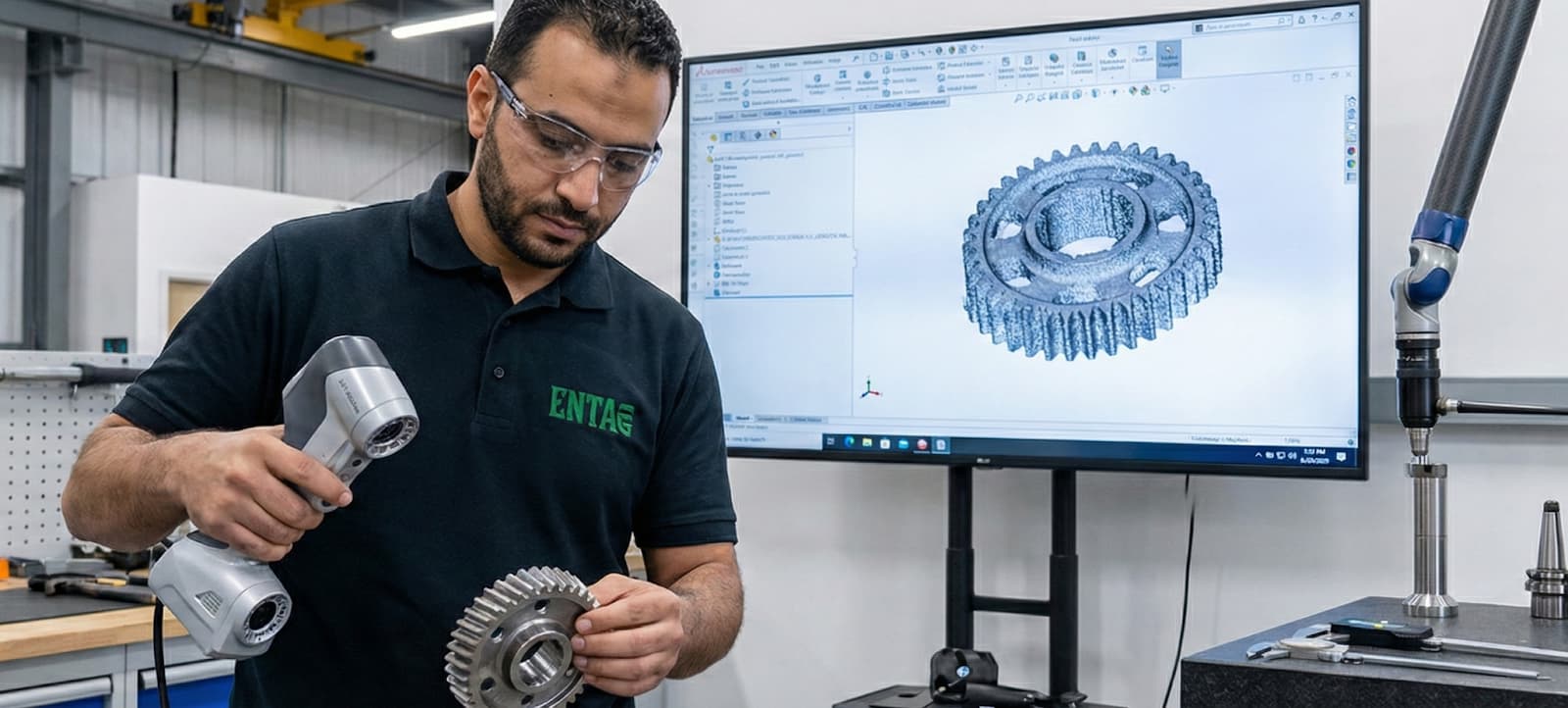


Reverse engineering requires accuracy. When technical drawings are missing, suppliers discontinue components, or parts degrade after years of operation, traditional measurement methods cannot capture complex geometry with adequate precision.
3D scanning solves this problem by generating a detailed digital representation of any physical object. Using a 3D scanner in Egypt, engineers can capture millions of data points, convert them into clean CAD models, and manufacture replacements through CNC machining or 3D printing.
Today, factories across Cairo and the Middle East rely on 3D laser scanning to reduce downtime, eliminate guesswork, and accelerate product development.
Manual measurements are slow and prone to error — especially for worn surfaces, castings, and complex free-form shapes.
A professional 3D scanner captures high-resolution geometry instantly, enabling:
This eliminates uncertainty in engineering workflows where precision is mandatory.
3D scanning performance depends heavily on accuracy, resolution, and the type of scanner used. For industrial reverse engineering, metrology-grade specifications ensure that CAD reconstruction is reliable and ready for CNC machining.
These capabilities allow engineers to capture even the most complex geometry with confidence.
3D scanning has become a core tool in reverse engineering, allowing engineers to capture accurate geometry, rebuild missing CAD models, and reproduce parts with perfect precision. Below are the key applications where 3D scanning delivers the highest value.
Industrial plants across Egypt run machinery that is 10–30+ years old. Documentation is often missing, and OEMs may no longer exist.
3D scanning allows engineers to:
No supplier dependency. No long import timelines.
A 3D laser scanner in Egypt captures all external geometry, enabling conversion into:
These CAD models integrate directly with:
This ensures consistent manufacturing quality.
Components exposed to friction, vibration, or heat lose dimensional accuracy.
3D scanning can:
This is especially useful for pump components, shafts, housings, and gear covers.
.webp)
3D scanning is frequently used to accelerate prototyping by eliminating manual CAD modeling. Engineers can scan:
The resulting 3D models feed directly into 3D printing or machining, speeding up validation.
Free-form shapes cannot be measured with calipers. Laser scanning is used for:
High-resolution point clouds preserve all curvature transitions and fine features.
3D scanning is also used to verify manufactured parts by:
This is essential in CNC machining and metal fabrication where tolerances matter.
A 3D scanner in Egypt helps factories create digital archives of critical components:
This builds long-term operational stability.
A food processing facility in Cairo experienced repeated breakdowns due to a cracked aluminum gear housing on an imported conveyor line. The part was over 12 years old, and the OEM no longer supplied replacements. Manual measurement was impossible due to complex interior cavities.
A professional 3D laser scanner was used to capture both the internal and external geometry in less than 20 minutes. Engineers cleaned the scan, reconstructed a manufacturable 3D CAD model, and generated full 2D technical drawings with corrected tolerances and reinforced areas to prevent future failures.
The replacement housing was CNC-machined from aluminum and installed within 72 hours.
Result: The plant avoided extended downtime, gained full digital documentation, and upgraded the part’s structural integrity — all without relying on foreign suppliers.
Professional reverse engineering relies on advanced hardware and specialized metrology software. Using industry-leading tools ensures accuracy, repeatability, and clean conversion to CAD.
This toolset ensures that the final CAD model meets both manufacturing and inspection requirements.
3D scanning is rapidly transforming industrial workflows across the country. The technology supports diverse sectors where dimensional accuracy is critical.
The shift toward digital manufacturing across Cairo, Alexandria, and the wider Middle East is driven by:
3D scanning provides precision, speed, and complete control over critical engineering data.
3D scanning has become a core tool for industrial reverse engineering.
By capturing precise geometry, enabling accurate CAD reconstruction, and integrating seamlessly with CNC machining and 3D printing, scanning eliminates the guesswork that slows down engineering projects.
Whether restoring worn parts, reproducing obsolete components, or validating prototypes, 3D scanning gives Egyptian manufacturers the accuracy and speed needed to stay competitive.
Q1: What is the accuracy of 3D scanning?
Accuracy typically ranges between ±0.02 mm and ±0.05 mm depending on the scanner and part size.
Q2: Can you scan large parts or machines?
Yes — multiple scans can be aligned to capture large structures or assemblies.
Q3: Can damaged or worn parts be scanned?
Absolutely. Scanning helps recover the original geometry by reconstructing missing or deformed areas.
Q4: What file formats do you deliver?
We provide STL, STEP, IGES, Parasolid, PLY, and OBJ depending on your manufacturing needs.
Q5: Do you offer on-site scanning?
Yes, on-site scanning is available for factories in Cairo, Alexandria, and nearby regions.
Q6: Can the scan be used directly for CNC machining?
Yes — after reverse engineering, the CAD model can be used for CNC machining, sheet metal processing, or 3D printing.