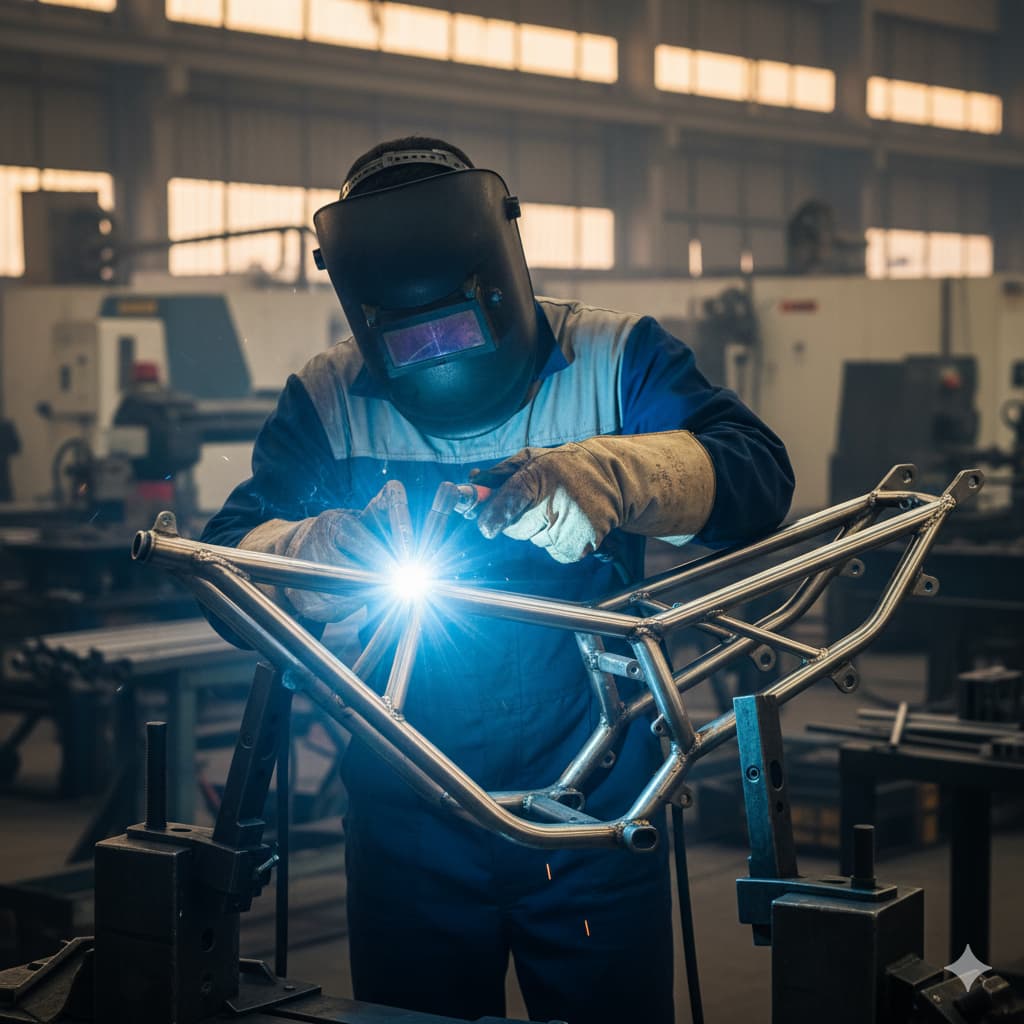


In motorcycle manufacturing, motorcycle components that form the chassis determine handling, safety, and long-term durability. A motorcycle frame is not merely welded tubing—it is a structural system where bend accuracy, tube integrity, and joint quality directly affect performance.
Tube-bent motorcycle chassis components must meet strict dimensional and mechanical requirements. Errors in bending or welding introduce residual stresses, misalignment, and fatigue risks. This is why professional CNC tube bending services, springback compensation, and precision tube notching are essential for reliable motorcycle chassis fabrication.
Tube-bent chassis components are structural tubes formed to specific radii and angles, then cut, notched, and welded into a complete frame assembly.
Common components include:
These parts experience vibration, torsion, and cyclic loading throughout service life, making geometry control and weld integrity non-negotiable.
CNC tube bending delivers repeatability and accuracy that manual methods cannot.
Key advantages:
Typical bend tolerances for chassis tubes range from ±0.5° to ±1°, depending on tube diameter, wall thickness, and material grade.
A core challenge in tube bending is springback—the elastic recovery that causes a tube to partially return toward its original shape after bending.
In professional chassis fabrication:
By embedding springback compensation into CNC programs, final bend angles land within tolerance without manual correction, reducing scrap and rework.
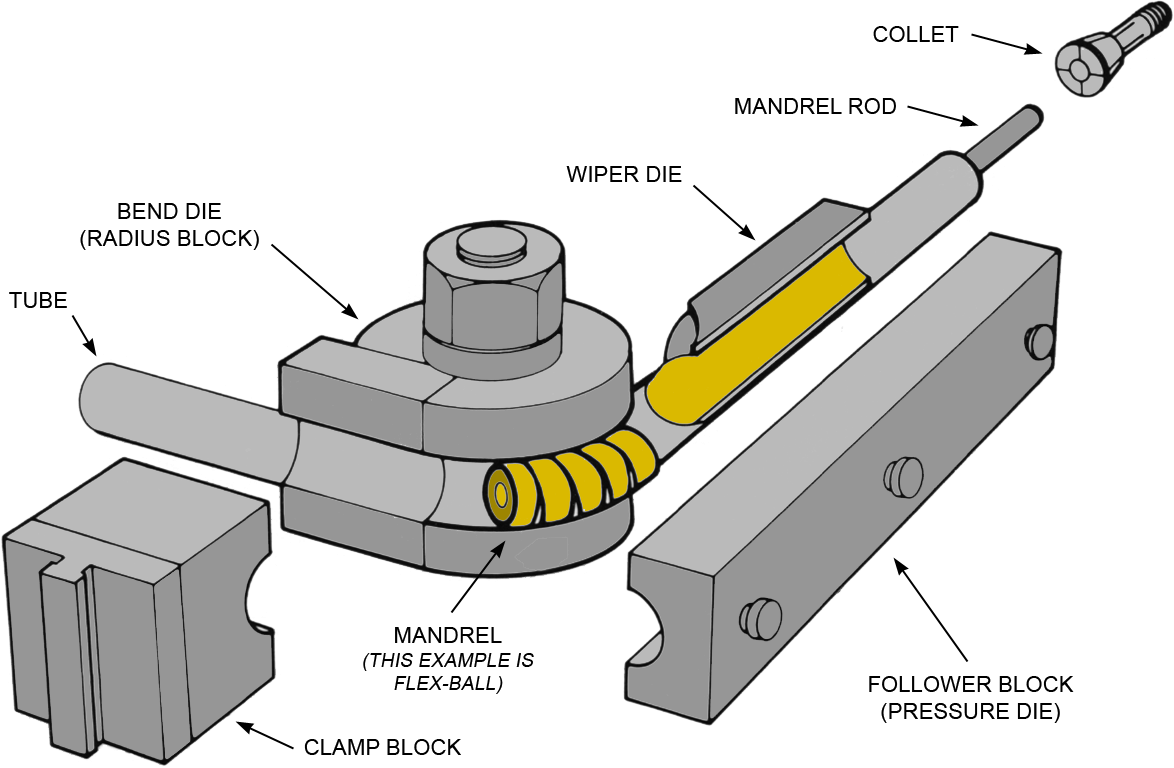
A hallmark of expert tube bending is understanding the Diameter-to-thickness ratio (D/t).
Industry rule of thumb:
For motorcycle chassis tubes—where strength and fatigue life matter—respecting the D/t ratio ensures the tube maintains its structural cross-section through the bend.
| Feature | Mandrel Bending | Non-Mandrel Bending |
|---|---|---|
| Internal Support | Yes (mandrel) | No |
| Ovality Control | Excellent | Limited |
| Suitability for High D/t | Yes | No |
| Best Use | Structural chassis tubes | Non-critical tubes |
| Cost | Higher | Lower |
For load-bearing motorcycle frame components, mandrel bending is typically required—especially when D/t ratios are high.
Material choice affects stiffness, fatigue resistance, and weldability.
Common materials include:
Typical wall thickness ranges from 1.5 mm to 3.0 mm, depending on design loads and geometry.
Our expertise extends to complex motorcycle chassis tube bending, delivering lightweight, high-strength frames for performance vehicles
Before welding, tubes must be notched (fish-mouthed) to fit flush against mating tubes. Poor notching leads to gaps, excessive weld filler, and weak joints.
In professional motorcycle chassis fabrication, CNC tube notching is a companion process to bending—not a secondary operation.
After bending and notching, tubes are assembled in fixtures and welded into the final chassis.
Key welding considerations:
A critical factor is the Heat-Affected Zone (HAZ)—the region adjacent to the weld where material properties can degrade due to heat. Precise CNC notching allows for lower heat input, which reduces HAZ size and helps preserve the strength and fatigue resistance of the parent tube material.
TIG welding is commonly used for motorcycle frames due to its control and clean weld profile, especially on thinner-wall tubes.
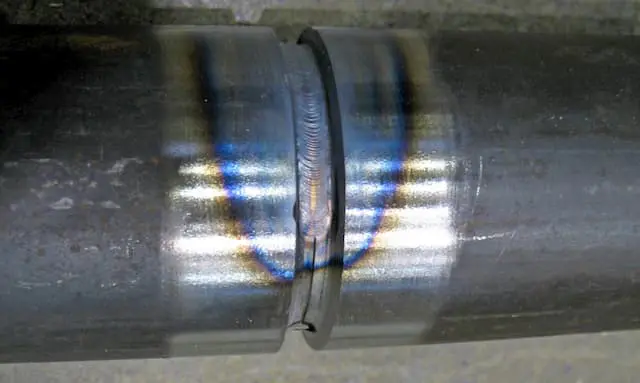
Structural metal fabrication for motorcycle chassis requires inspection at multiple stages.
Quality checks include:
Identifying deviations early prevents compounding errors later in assembly.
Challenge:
A custom builder faced alignment issues and inconsistent weld quality caused by manual bending and hand-notched joints.
Solution:
Result:
We specialize in precision tube bending for automotive applications, from roll cages to custom exhaust systems, ensuring safety and performance
Metal fabrication in Egypt has advanced significantly in CNC tube bending, notching, and welded structural assemblies.
Advantages of manufacturing in Egypt include:
At Entag, motorcycle chassis components are produced through vetted partners specializing in metal forming tubes, CNC notching, and structural welding.
Precision fabrication is now a competitive advantage—not just a manufacturing detail.
Need CNC tube bending, tube notching, or welded motorcycle chassis components?
Talk to Entag to source precision-formed motorcycle components built for alignment, strength, and repeatability.
What is springback in tube bending?
Springback is the elastic recovery of a tube after bending. CNC programs compensate by over-bending to achieve accurate final angles.
When is mandrel bending required?
When the D/t ratio is 15 or higher, mandrel support is typically required to prevent collapse and ovality.
Why is CNC tube notching important before welding?
Accurate notching ensures flush joints, lower heat input, smaller HAZ, and stronger welds.
Can motorcycle chassis components be manufactured in Egypt?
Yes. CNC tube bending, notching, welding, and structural fabrication are available locally, especially in Cairo.
Tube-bent motorcycle chassis components demand precision at every stage—bending, springback compensation, D/t ratio control, notching, and welding. When these factors are engineered correctly, manufacturers achieve stronger frames, better alignment, reduced HAZ effects, and longer service life. Precision fabrication translates directly into performance and reliability on the road.
Looking for motorcycle components, CNC tube bending, or structural metal fabrication in Egypt?
Upload your files to manufacture chassis components engineered for accuracy, strength, and real-world performance.